

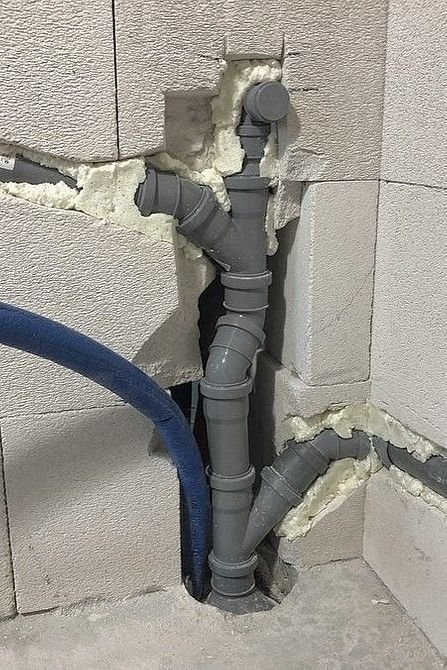
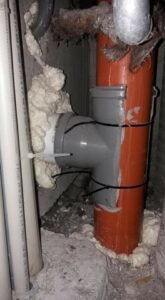
🔍 Summary of the Problem
Improper Joint Connection:
A PVC (white) pipe is connected to an orange/gray sewer or drainage pipe using a mix of foam sealant and cable ties.
These are not proper sealing or support methods for plumbing.
Foam Used Incorrectly:
Expanding foam is used to fill gaps, not to seal water or waste joints — it’s not watertight and can fail under pressure or heat.
Unsupported / Weak Joint:
Cable ties are used to hold the fitting together. This can easily loosen and cause leaks or disconnections over time.
Potential Leak & Mold Risk:
Foam around the joint may trap moisture, encouraging mold or corrosion of nearby metal pipes.
🛠️ Proper Way to Fix It
Remove the Improvised Materials:
Cut away the foam and remove cable ties.
Clean both pipe ends thoroughly.
Check Compatibility:
Identify both pipe types (PVC, ABS, or cast iron).
If they’re different materials, use a proper transition coupling (e.g. a rubber Fernco coupling with hose clamps).
Install a Correct Fitting:
Use a PVC or ABS Y/T-fitting rated for drainage, matching pipe diameters.
Use solvent cement for PVC-to-PVC joints or rubber couplers for mixed materials.
Support the Pipe Properly:
Use pipe clamps or hangers instead of cable ties.
Ensure no stress or weight is on the joint.
Seal the Wall Opening:
After the pipe is secure, use non-expanding foam or cement mortar only to fill wall gaps — not to seal the pipe itself.
